How Patent Damages Are Calculated and When Enhanced Damages Apply
When a patent owner proves infringement, the next critical question is how much compensation they are entitled to receive. Patent damages represent the financial harm caused by the unauthorized use of patented technology.
In the United States, patent damages are governed by 35 U.S.C. § 284, which provides that a court shall award damages adequate to compensate for the infringement. Understanding how these are calculated is essential for patent owners considering enforcement and for investors evaluating litigation funding opportunities.
The Two Primary Methods for Calculating Patent Damages
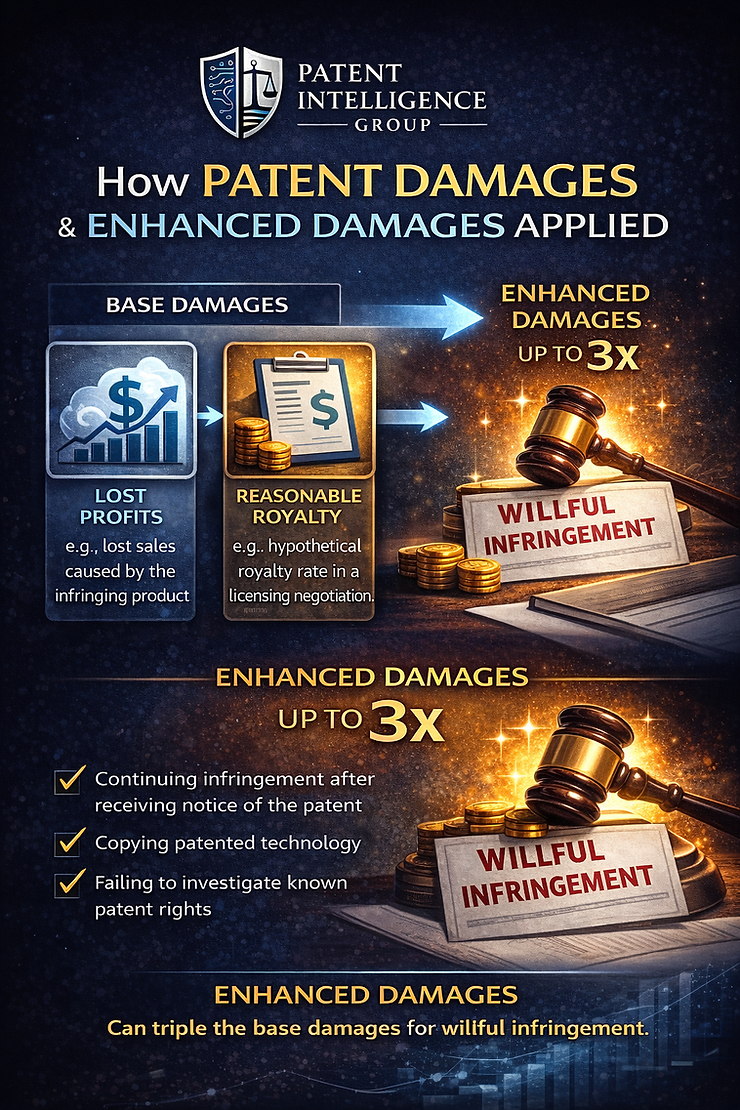
Courts typically calculate patent damages using one of two primary methods: Lost Profits or a Reasonable Royalty. Both approaches attempt to estimate the financial harm suffered by the patent owner.
1. Lost Profits
Lost profits damages are awarded when a patent owner can show they would have made the sales captured by the infringing product. To recover these, the owner generally must demonstrate:
-
Demand for the patented product.
-
Lack of acceptable non-infringing alternatives.
-
Manufacturing and marketing capability to meet that demand.
-
The specific amount of profit the owner would have earned.
Courts often apply the Panduit factors, a well-known framework used to determine if lost profits are appropriate. When proven, these damages can be substantial as they reflect the full profit margin the owner missed out on.
2. Reasonable Royalty
If lost profits cannot be established, courts award damages based on a reasonable royalty. This represents the payment the infringer would have agreed to in a “hypothetical negotiation” with the patent owner before the infringement began.
Courts frequently rely on the Georgia-Pacific factors to determine the rate. These include:
-
Existing licensing agreements and industry royalty rates.
-
The importance of the patented technology to the product.
-
The profitability of the accused products.
-
The relationship between the parties.
The reasonable royalty approach is the most common method used in patent litigation.
Additional Types of Patent Damages
In specific cases, damages calculations may include:
-
Price Erosion: If infringement forced the patent owner to lower their own prices to compete, they can claim the lost revenue caused by those reductions.
-
Convoyed Sales: Profits from related products (like accessories or service contracts) sold alongside the patented technology.
-
Future Damages: Ongoing royalties if the infringement continues after a court judgment.
Enhanced Damages for Willful Infringement
Under 35 U.S.C. § 284, courts may award up to three times (treble) the amount of damages if the infringement is determined to be willful. This generally involves situations where the infringer knowingly or recklessly disregarded the patent owner’s rights, such as:
-
Continuing infringement after receiving formal notice.
-
Explicitly copying the patented technology.
-
Failing to investigate known patent rights.
Enhanced damages are intended to punish egregious misconduct and deter deliberate infringement.
Why Damages Matter for Litigation Funding
Damages calculations are central to attracting litigation finance. Because patent litigation can cost millions, firms evaluate whether the potential recovery justifies the risk. Many investors prefer cases where potential damages exceed $20 million.
At Patent Intelligence Group, damages analysis is a core part of our Patent Litigation Funding Readiness Framework™, specifically during the Litigation Viability Report stage. This ensures a case meets the economic thresholds required by funders before moving forward.
The framework includes:
-
Infringer Landscape Report
-
Evidence-Backed Claim Chart Report
-
Litigation Viability Report
-
Investment Diligence Report
Conclusion
Understanding damages—from lost profits to enhanced penalties for willfulness—helps patent owners evaluate their case’s strength. The Patent Litigation Funding Readiness Framework™ provides the structured approach needed to assess this potential before pursuing enforcement.
Email us at info@patentintelligencegroup.com to see how we can help!