IP Due Diligence Requires an Independent Review: Why Your Deal Counsel Isn’t the Right Person
You are three weeks from signing. The target is a mid-market technology company with a dense patent portfolio, a handful of pending applications, and a founder who describes the company’s IP as “bulletproof.” The data room is populated. Your outside counsel has been working the file for a month. The QofE is back. The LOI is exclusive, the committee has already seen the deck twice, and the wire instructions are sitting in a draft email.
Then someone on the investment team asks a question that nobody has a good answer to: “Has anyone actually looked at the patents?”
What usually follows is a polite round of reassurances. Counsel confirms the IP schedule matches the USPTO records. The target’s CTO says there are no known infringement issues. A junior associate produces a one-page memo noting that the patents are in good standing and that maintenance fees are current. The box gets checked. The deal closes.
And then, sometime between month six and month eighteen, one of three things happens. A competitor sends a letter. A key claim gets invalidated in an IPR nobody was tracking. Or the “core patent” that anchored the valuation turns out to read on exactly nothing the company actually sells. By then, the check has cleared, the operators are in place, and the only question left is how big the write-down is going to be.
This is not a rare story. In IP-intensive deals, it is the most common failure mode we see — and it almost always traces back to the same structural problem: the people telling you the IP is fine are the same people whose livelihood depends on the deal closing.
The Incentive Problem Nobody Wants to Name
Let us be direct about something the industry tends to whisper around. When a deal team hires outside counsel to handle a transaction, that firm is on the clock from the moment the engagement letter is signed until the wire hits. Their job — the thing they were hired to do, the thing their partners are measured on — is to get the deal done. A closed deal is a successful engagement. A killed deal is a fee dispute waiting to happen and a referral source that goes cold.
This is not a criticism of lawyers. It is a description of the economic reality of how deal work is structured. Outside counsel at any reputable firm will tell you honestly about problems they find. But the gravitational pull of a live transaction bends everything toward the close. Issues get characterized as manageable. Red flags get softened into “points to address post-closing.” And the questions that would have killed the deal if asked in week one somehow never quite get asked at all.
The problem is magnified in IP. Most deal counsel are corporate lawyers. They are extraordinarily good at what they do — drafting, negotiating, structuring, allocating risk between the four corners of a purchase agreement. What they are not, with rare exceptions, is patent attorneys who have actually prosecuted, litigated, or invalidated claims. So when the IP schedule shows twelve issued patents and four pending applications, the corporate team confirms the paperwork is in order, asks the target to represent that the company owns what it says it owns, and moves on. The substance of whether those patents are actually worth anything — whether they cover the product, whether they would survive a challenge, whether a competitor already has a blocking position — rarely gets touched.
If it does get touched, it is usually outsourced to the IP group at the same firm. Which means the same economic pressure applies, now with an additional wrinkle: that IP partner may be hoping to pick up the target as a prosecution client post-close. The incentive to find problems that might kill the deal is, to put it gently, not high.
What “IP Diligence” Usually Looks Like Inside a Data Room
If you have been on enough deals, you have seen the pattern. The IP diligence section of the report typically contains some version of the following:
- A list of issued patents and applications pulled from the USPTO and matched to the target’s schedule.
- Confirmation that maintenance fees are current and that there are no obvious ownership gaps in the assignment chain.
- A statement that the target has represented there is no known pending or threatened litigation.
- A note on whether any material licenses are in place and whether they survive a change of control.
- A short section on trademarks, which frankly nobody reads.
That is a legitimate administrative review. It is also not an answer to any of the questions a PE buyer actually needs answered about an IP-driven asset. It tells you whether the paperwork is tidy. It does not tell you whether the patents are worth the valuation the deal is assuming.
The questions that matter — the ones that should be answered before you commit capital — look nothing like the bullet list above.
The Questions a Real IP Review Answers
When we run an independent patent review for a PE buyer, we are trying to answer four things. They are simple to state and harder than most people realize to answer honestly.
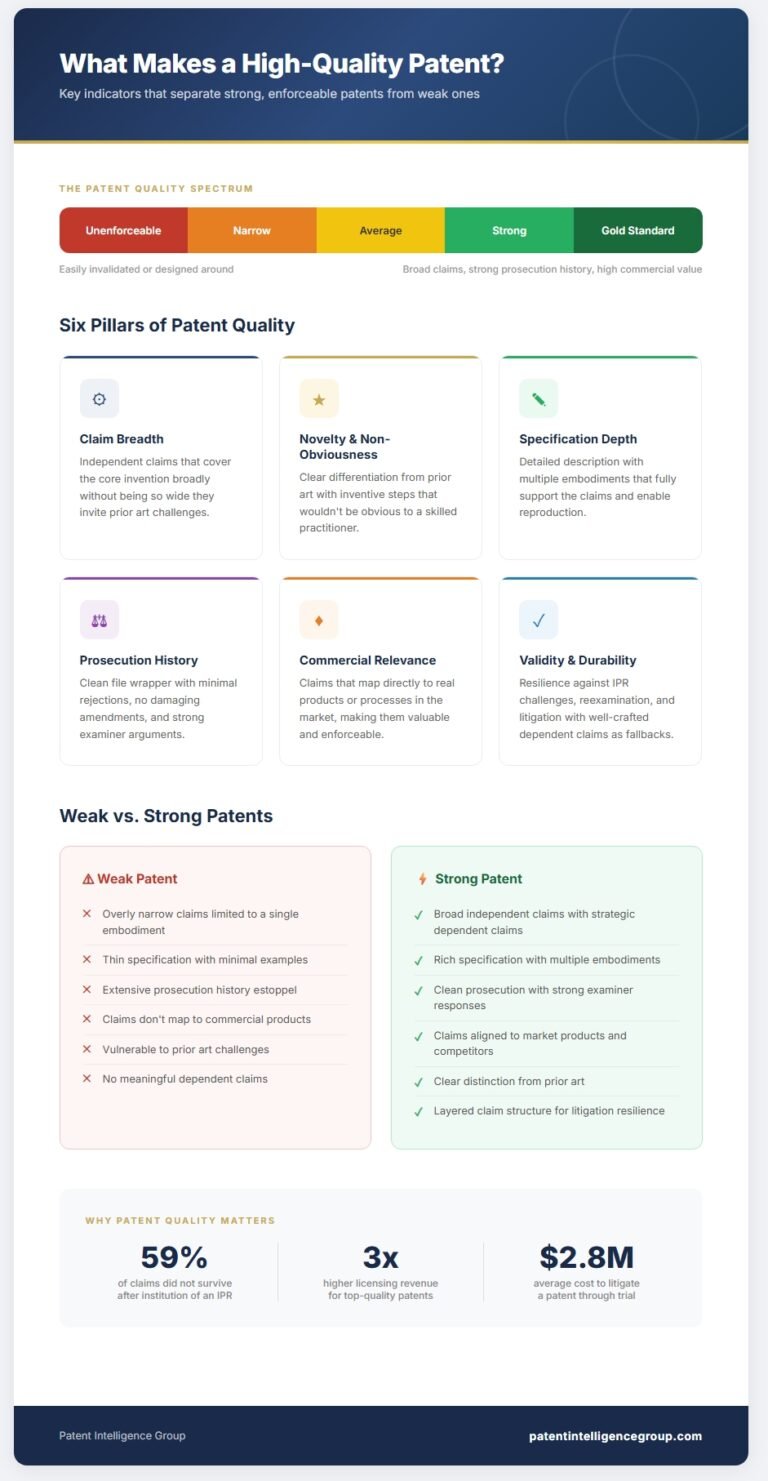
First: does the patent actually cover the product? This sounds obvious. It is not. It is extraordinarily common for a target’s “core patent” to have claims that read on an earlier version of the product, a version that was abandoned, or a theoretical embodiment that was never commercialized. The claim language and the product specifications drift apart over years of iteration, and nobody notices until someone reads the claims carefully against what the company is actually shipping. If the claims do not read on the revenue-generating product, the patent is not protecting the business — it is decoration.
Second: would the patent survive a serious challenge? A patent that has never been tested is a Schrödinger’s asset. It is simultaneously valid and invalid until someone attacks it. The question for a buyer is not whether the patent issued — the Patent Office issues a lot of patents that would not survive an inter partes review. The question is whether the claims, if challenged by a motivated competitor with prior art in hand, would still be standing a year later. This requires an actual prior art search. It requires reading the file history. It requires knowing what a PTAB panel is likely to do with the strongest combinations. It is rarely done inside a 30-day deal timeline, and when it is skipped, the buyer inherits a liability disguised as an asset.
Third: is there a blocking position the target does not know about? Freedom-to-operate is the single most important question in most IP-intensive deals, and it is almost never asked properly. The target will tell you they are not aware of any infringement issues. Their counsel will confirm no letters have been received. Neither of those statements is the same as saying no one has a blocking patent. In mature technology spaces, there is almost always a dominant patent holder with a position that touches the target’s product. Sometimes they are asleep. Sometimes they are waiting for the target to get acquired by someone with deeper pockets. A real FTO review finds them before the deal closes, not after.
Fourth: what does the competitive landscape actually look like? The patent record is the closest thing the market has to a truth serum about what competitors are really building. A proper landscape analysis will tell you whether the target’s technical moat is real, whether a better-funded competitor is two years from releasing something that obsoletes the portfolio, and whether the “first mover advantage” in the deck is supported by the filing record or contradicted by it. This is where patent intelligence stops being a legal compliance exercise and starts being an investment thesis stress test.
Why Independence Matters More Than Expertise Alone
There are good IP lawyers at good firms who could, in principle, answer all four of these questions. The problem is not capability. The problem is structural. When the party doing the review has any financial interest in the deal closing — whether because they are the deal counsel, because they hope to be the post-close counsel, or because they are trying to protect a referral relationship with the sponsor — the review is compromised before it starts.
Independence is the thing that lets the reviewer say, plainly and without hedging, “this patent does not cover the product and the valuation assumes that it does.” A deal counsel can technically say that. In practice, they almost never do, because the social and economic cost of being the person who killed the deal is too high. An independent reviewer has no such cost. The only product we are selling is the truth about what the IP actually is. If the deal should close, we will tell you. If it should not, we will tell you that too, and we will show our work.
This is also why we are hired more often as a second opinion than as a first one. Sponsors bring us in after their own counsel has delivered a clean report and something still feels off. In a meaningful percentage of those engagements, what “felt off” turns out to have been exactly right — a core claim that does not read on the product, an FTO risk nobody flagged, a prior art reference sitting in the file history that would invalidate the key patent in an afternoon.
What This Looks Like in Practice
An independent IP review on a typical mid-market deal takes us two to three weeks. It is priced as a fixed engagement, not billed hourly, which removes any incentive on our side to pad the work. The deliverable is a written report that addresses each of the four questions above in language a non-lawyer investment committee can actually use — claim charts where needed, plain-English summaries of the FTO risk, and a clear recommendation about whether the IP supports the valuation thesis.
We do not replace your deal counsel. We are not trying to. What we do is give the investment committee a second set of eyes whose only job is to be right about the patents, with no dog in the fight over whether the deal closes. In the deals where the IP is genuinely solid, the report becomes part of the support for the investment decision. In the deals where it is not, the report is the reason the committee retrades the price, restructures the reps, or walks away with its capital intact.
The cost of an independent review is a rounding error against the size of the checks being written on these deals. The cost of skipping one — and discovering the problem after the wire clears — is on a different order of magnitude entirely.
The Check the Committee Should Be Asking For
If you are a deal partner or an investment committee member reading this, the question to ask on your next IP-intensive transaction is not “Did our counsel look at the patents?” The answer to that question will always be yes, and it will always be technically true. The question to ask is: “Did anyone without a financial interest in closing this deal actually test whether the patents cover the product, would survive a challenge, and leave us free to operate?”
If the answer is no, you are making the investment decision with the most important piece of information missing. That is a fixable problem, and it is a much cheaper problem to fix before close than after.
If you have a deal on your desk right now and want an independent second opinion before the committee meets, contact us directly and we will tell you within 48 hours whether an independent review makes sense for your situation.
Patent Intelligence Group provides independent patent diligence and IP risk analysis for private equity investors, corporate acquirers, and innovation-driven companies. We work only for buyers, we are not retained as deal counsel, and we have no interest in whether any particular deal closes — only in whether the IP actually supports the thesis.