
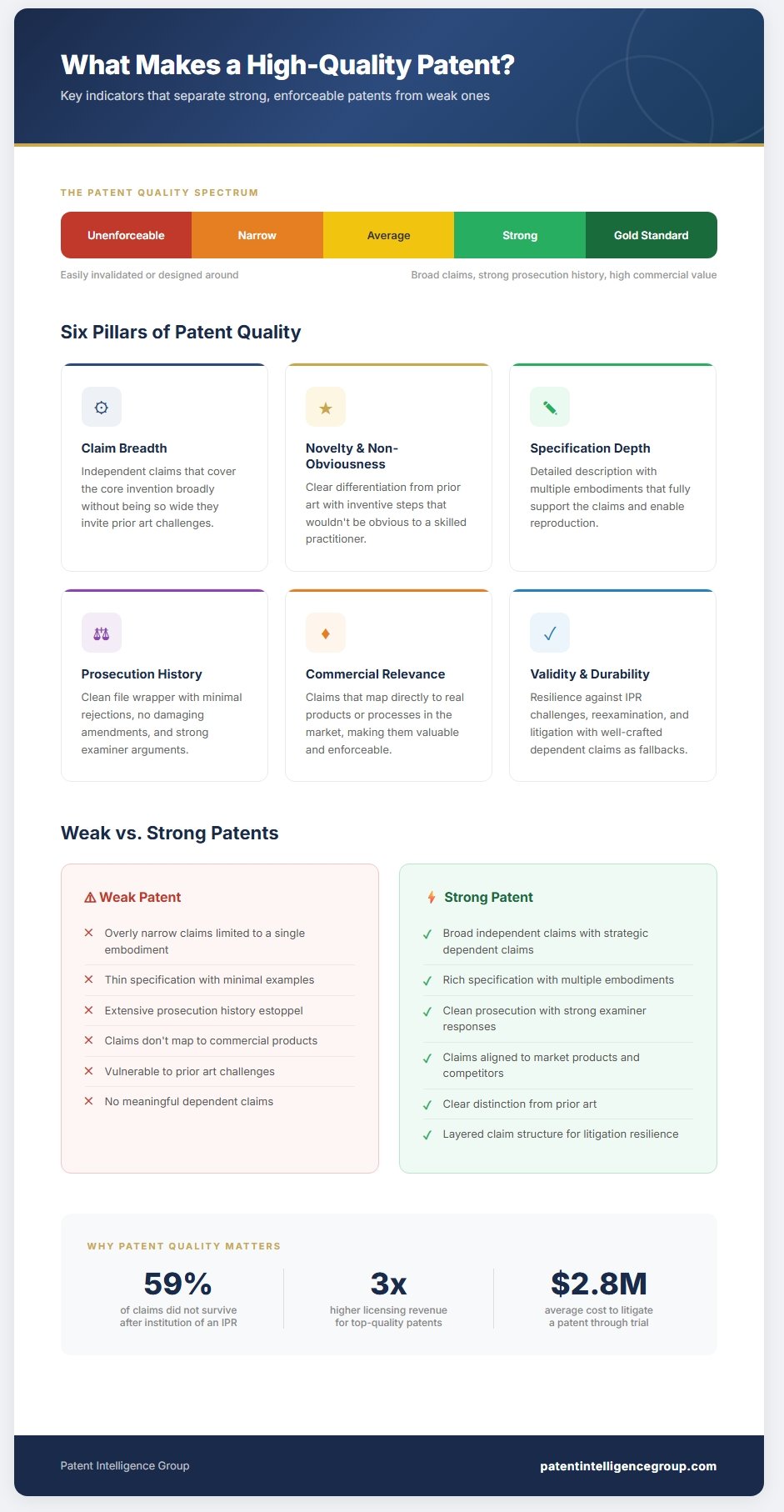
Every Private Equity Firm Orders a Quality of Earnings. Almost None of Them Order a Quality of Patents.
You would never close an acquisition without a Quality of Earnings report. The idea of relying on the target’s own financials — without an independent third party stress-testing the numbers — would be unthinkable. No investment committee would approve it. No lender would fund it.
So why does almost every PE firm do exactly that with the target’s patents?
On IP-intensive deals, the standard approach to patent diligence looks almost identical to what financial diligence looked like thirty years ago, before QofE reports became standard: the target tells you what it has, counsel confirms the paperwork is in order, and everybody moves on. Nobody stress-tests the claims. Nobody maps them against the actual product. Nobody checks whether a competitor has a blocking position. The investment committee sees a line in the diligence report that says “IP: no issues identified” and assumes someone actually looked.
That is not diligence. That is a filing exercise.
What a QofE Does That IP Diligence Currently Does Not
A Quality of Earnings report exists because everyone learned the hard way that targets present their financials in the most favorable light possible. Revenue gets pulled forward. One-time gains get buried in recurring line items. Expenses get deferred. The numbers are technically accurate and practically misleading. The QofE strips away the presentation and shows you what the economics actually look like.
Patent portfolios have the exact same problem. The target will tell you they have twelve issued patents, four pending applications, and “strong IP protection” in their core market. That is technically accurate. It is also practically meaningless without answers to the questions that actually drive value:
— Do the patent claims actually cover the product the company sells today, or did the product evolve past the claims three years ago?
– Would the key patents survive an inter partes review if a motivated competitor filed one next quarter?
— Is there a third party with a blocking patent position that nobody has flagged because nobody ran an FTO search?
— Does the filing record support the “first mover advantage” narrative in the deck, or does it show two better-funded competitors with overlapping positions?
A QofE answers the financial version of these questions. A Quality of Patents report answers the IP version. The difference is that every deal gets the first one and almost no deal gets the second.
Why the Gap Exists
The gap is not because buyers do not care about IP. It is because the current diligence structure was not designed to catch IP problems.
Deal counsel handles the transaction. They are corporate lawyers. They are excellent at structuring deals, allocating risk, and drafting purchase agreements. They are not, with rare exceptions, patent attorneys who have prosecuted applications, defended IPRs, or mapped claims against products. When they look at a patent schedule, they are confirming that the target owns what it says it owns. They are not testing whether what the target owns is actually worth anything.
Sometimes the deal firm will loop in their own IP group. But that creates a second problem: the IP partner is at the same firm billing seven figures on the deal. The same firm that hopes to be post-close counsel for the platform company. The incentive to deliver a report that says “significant unresolved patent risk — recommend repricing or walking” is not high.
The result is that IP diligence on most mid-market PE deals amounts to an administrative review dressed up as substantive analysis. The committee sees it, checks the box, and moves on. The problems show up twelve to eighteen months later when someone sends a cease-and-desist letter, a key claim gets invalidated, or the “core patent” turns out to be unenforceable.
What a Quality of Patents Report Actually Looks Like
A real Quality of Patents engagement mirrors the QofE model in the ways that matter: it is conducted by an independent specialist, scoped to a fixed fee, and delivered in language the investment committee can use.
Here is what it covers:
— Claim-to-product mapping: do the patent claims actually read on what the company sells?
— Validity risk assessment: how would the key patents hold up under a serious prior art challenge?
— Freedom-to-operate analysis: does anyone else have a patent position that could block the target’s core products?
— Competitive landscape review: what does the patent filing record say about who else is building in this space?
— Ownership and chain of title: are there gaps, co-inventors with unassigned rights, or license obligations that survive the acquisition?
The deliverable is a written report with claim charts where needed, plain-English risk summaries, and a clear recommendation. Not a memo that says “no issues identified.” An actual analysis that the committee can weigh against the purchase price.
The engagement typically takes two to three weeks on a mid-market deal. The cost is a fraction of the QofE. The ROI, when it catches a problem, is measured in multiples of the entire deal fee.
The Question to Ask on Your Next Deal
The next time you are on an investment committee reviewing an IP-intensive target, ask one question: “Did we get an independent Quality of Patents report, or did we rely on deal counsel’s administrative review?”
If the answer is the second one, you are making the same bet that buyers made on financials before QofE reports became standard — trusting the target’s own narrative about what the numbers mean, without an independent party testing whether it is true.
That worked out badly enough with earnings. It works out worse with patents, because by the time the problem surfaces, there is no restatement. There is just a write-down.
The independent patent opinion your investment committee deserves.
Patent Intelligence Group provides independent patent diligence for private equity investors, litigation finance funds, and corporate acquirers. We work only for buyers. We are not deal counsel. We have no interest in whether any particular deal closes — only in whether the IP actually supports the thesis.
If you have a deal on your desk and want a second opinion before the committee meets, reach out. We will tell you within 48 hours whether an independent review makes sense for your situation.
info@patentintelligencegroup.com patentintelligencegroup.com