

Equity Investment Fund: A Guide for Investors in 2026
An equity investment fund represents a pooled investment vehicle that enables multiple investors to collectively invest in a diversified portfolio of stocks and equity securities. These funds have become fundamental components of modern investment portfolios, offering both institutional and individual investors access to professionally managed equity exposure across various market segments. Understanding how these investment vehicles operate, their distinct characteristics, and the due diligence process required to evaluate them has become increasingly critical for sophisticated investors, particularly those seeking to assess the underlying value drivers of portfolio companies.
Understanding the Equity Investment Fund Structure
An equity investment fund pools capital from multiple investors to purchase ownership stakes in companies through publicly traded stocks, private equity investments, or a combination of both approaches. The fund structure allows smaller investors to access diversified portfolios that would otherwise require substantial capital commitments.
Types of Equity Investment Funds
Different fund structures serve distinct investor needs and risk profiles. The Investment Company Institute provides comprehensive information on equity funds and their various classifications within the broader investment landscape.
Mutual Funds operate as open-end investment vehicles, continuously issuing and redeeming shares based on investor demand. These funds calculate their net asset value (NAV) daily, allowing investors to enter or exit positions at the current market price.
Exchange-Traded Funds (ETFs) combine features of mutual funds with the trading flexibility of individual stocks. These instruments trade on exchanges throughout the day, offering real-time pricing and typically lower expense ratios than traditional mutual funds.
Private Equity Funds represent closed-end structures that invest directly in private companies or take public companies private. These funds typically maintain longer investment horizons, often ranging from five to ten years, and require substantial minimum investments from accredited investors.
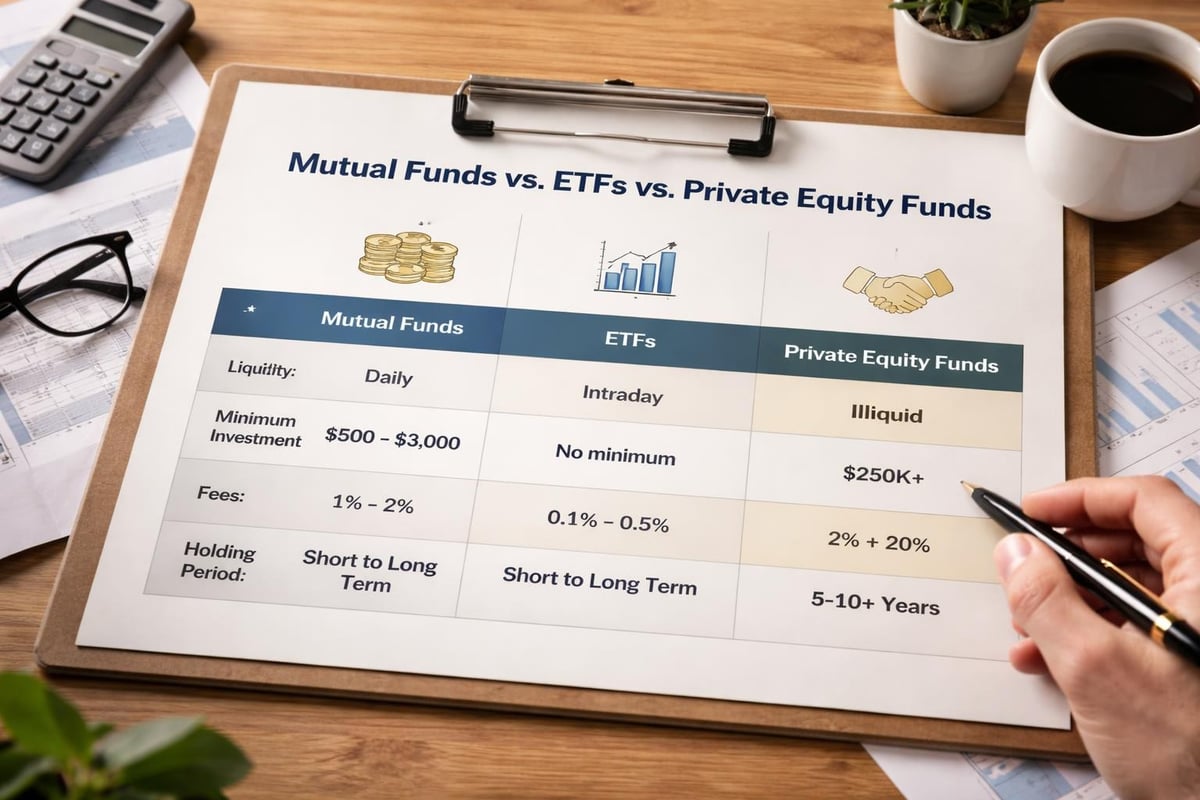
| Fund Type | Liquidity | Minimum Investment | Fee Structure | Typical Holding Period |
|---|---|---|---|---|
| Mutual Funds | Daily redemption | $500 – $3,000 | Management fees 0.5% – 2.0% | Flexible |
| ETFs | Intraday trading | One share price | Expense ratios 0.03% – 0.75% | Flexible |
| Private Equity | Limited/Quarterly | $250,000+ | 2% mgmt + 20% carry | 5-10 years |
| Hedge Funds | Monthly/Quarterly | $100,000 – $1M | 2% mgmt + 20% performance | 1-3 years |
Fund Management Approaches
Equity investment funds employ either active or passive management strategies. Active managers conduct research and analysis to select individual securities they believe will outperform the market. These professionals leverage fundamental analysis, technical indicators, and proprietary research to make investment decisions.
Passive strategies track specific market indices, aiming to replicate their performance rather than beat them. Index funds and many ETFs follow this approach, resulting in lower management fees and reduced portfolio turnover. The GuideStone Equity Index Fund demonstrates how passive funds allocate assets across sectors while maintaining low-cost structures.
Investment Strategies and Portfolio Construction
Equity investment funds implement various strategies based on their investment mandates, risk parameters, and target returns. Understanding these approaches helps investors align fund selections with their financial objectives.
Growth Versus Value Investing
Growth-oriented funds target companies expected to generate above-average earnings growth, often trading at premium valuations relative to their current earnings. Technology, healthcare innovation, and emerging consumer trends frequently dominate growth fund portfolios.
Value funds seek undervalued companies trading below their intrinsic worth, as determined through fundamental analysis. These funds often concentrate on mature industries, dividend-paying stocks, and companies experiencing temporary challenges that have depressed their market prices.
Geographic and Sector Focus
Many equity investment funds specialize in specific geographic regions or economic sectors. Domestic funds concentrate on companies within a single country, while international and global funds provide exposure to foreign markets. Sector-specific funds target industries such as technology, healthcare, financial services, or energy.
Regional allocation strategies include:
- Developed market funds focusing on established economies
- Emerging market funds targeting high-growth developing nations
- Frontier market funds investing in pre-emerging economies
- Regional funds concentrating on specific areas like Asia-Pacific or Europe
The Capital Group offers insights into equity investment strategies that address current market opportunities across different sectors and geographies.
Due Diligence Considerations for Fund Selection
Selecting an appropriate equity investment fund requires thorough analysis of multiple factors that influence performance, risk, and alignment with investor objectives. This evaluation process becomes particularly crucial when funds hold companies with significant intellectual property portfolios.
Performance Analysis and Benchmarking
Historical performance provides valuable context, though past results never guarantee future returns. Investors should examine returns across multiple time horizons, comparing fund performance against relevant benchmarks and peer groups.
Key performance metrics include:
- Absolute returns over 1, 3, 5, and 10-year periods
- Risk-adjusted returns using Sharpe and Sortino ratios
- Tracking error relative to benchmark indices
- Maximum drawdown during market corrections
- Consistency of performance across market cycles

Fee Structure and Cost Analysis
Investment costs directly impact net returns. An equity investment fund charging 1.5% annually must generate 1.5% higher gross returns than a 0.5% fund just to match its net performance.
Management fees compensate fund managers for their services, typically ranging from 0.03% for passive index funds to 2.0% or higher for specialized active strategies. Performance fees or carried interest arrangements, common in private equity funds, align manager compensation with fund performance.
Transaction costs, including brokerage commissions and bid-ask spreads, accumulate through portfolio rebalancing. High-turnover strategies incur greater trading costs, potentially eroding returns despite superior security selection.
Management Team Evaluation
The experience, track record, and stability of the fund's management team significantly influence outcomes. Investors should research manager tenure, investment philosophy consistency, and previous performance at other firms.
Portfolio manager changes represent critical inflection points. A fund's historical performance reflects decisions made by previous managers who may no longer influence strategy. When evaluating funds with recent management changes, investors must assess whether performance patterns will continue under new leadership.
Intellectual Property and Portfolio Company Valuation
For equity investment funds holding technology companies, pharmaceuticals, consumer brands, or other innovation-driven businesses, intellectual property assets often constitute substantial portions of company valuations. Understanding how funds evaluate and monitor these intangible assets provides insight into investment quality and risk management practices.
Patent Portfolios as Value Drivers
Companies with strong patent portfolios often command premium valuations based on their protected market positions and revenue streams. An equity investment fund investing in semiconductor companies, biotechnology firms, or software developers must assess patent quality, coverage breadth, and enforceability.
Patent strength influences competitive positioning in several ways. Exclusive rights granted through patents enable pricing power by preventing competitors from offering identical products. Licensing revenue from patent portfolios generates high-margin cash flows. Cross-licensing agreements facilitate market entry while avoiding litigation costs.
IP Due Diligence in Fund Investments
Sophisticated fund managers incorporate intellectual property analysis into their investment process, particularly during initial position establishment and ongoing portfolio monitoring. This evaluation identifies potential risks and validates assumptions underlying financial projections.
Critical IP assessment areas include:
- Patent validity and enforceability across key jurisdictions
- Freedom to operate analysis for core products and services
- Competitive patent landscape mapping
- Litigation history and outstanding disputes
- Patent expiration schedules and generic entry risks
- Trademark strength and brand protection measures
Patent Intelligence Group provides specialized patent intelligence services that help private equity firms and investors conduct comprehensive IP due diligence on portfolio companies and acquisition targets.
Ongoing Patent Monitoring
Market conditions and competitive dynamics evolve continuously. An equity investment fund holding positions in innovation-driven companies benefits from systematic patent monitoring that identifies emerging threats and opportunities.
New patent applications from competitors signal strategic direction and potential market entry. Patent grants strengthen or weaken competitive positions. Litigation filings create uncertainty and potential liability exposure. Patent expirations open markets to generic competition, particularly in pharmaceutical investments.
Regular patent portfolio reviews help fund managers make informed decisions about position sizing, holding periods, and exit timing based on evolving intellectual property landscapes.

Regulatory Framework and Compliance
Equity investment funds operate within complex regulatory environments designed to protect investors and maintain market integrity. Understanding these requirements helps investors evaluate fund transparency and governance quality.
Investment Company Act Requirements
The Investment Company Act of 1940 governs most mutual funds and closed-end funds in the United States. This legislation establishes standards for fund structure, disclosure requirements, and operational practices. Investment fund regulations vary significantly across jurisdictions, affecting how funds structure their operations and report performance.
Registered investment companies must provide detailed prospectuses outlining investment objectives, strategies, risks, fees, and historical performance. Semi-annual and annual reports disclose portfolio holdings, financial statements, and management discussions.
Accounting Standards and Reporting
Investment funds follow specific accounting standards that differ from operating companies. The PwC course on US GAAP for investment funds covers financial reporting requirements and disclosures applicable to these vehicles.
Fair value accounting requires funds to mark securities to market prices, creating transparency but also introducing volatility in reported NAV. Level 1, 2, and 3 asset classifications indicate the reliability of valuation inputs, with Level 3 assets requiring significant management judgment.
Risk Management in Equity Fund Investing
Every equity investment fund carries inherent risks that investors must understand and evaluate against their risk tolerance and investment objectives.
Market and Systematic Risk
Equity funds face broad market risk from economic cycles, interest rate changes, geopolitical events, and investor sentiment shifts. Even well-diversified funds decline during market corrections, as systematic factors affect most stocks simultaneously.
Beta measures a fund's sensitivity to market movements. A beta of 1.2 indicates the fund typically moves 20% more than the market in either direction. Lower beta funds offer relative stability during downturns but may lag during rallies.
Concentration and Specific Risk
Portfolio concentration creates both opportunity and risk. Focused funds holding 20-30 positions potentially generate higher returns through high-conviction investing but suffer greater volatility when individual holdings underperform.
Sector concentration amplifies specific industry risks. Technology-heavy funds benefit from innovation cycles but face challenges during tech downturns. Geographic concentration exposes investors to region-specific economic and political factors.
Liquidity Risk Considerations
An open-end fund must maintain sufficient liquidity to meet redemption requests. Funds holding illiquid securities face challenges during market stress when investors simultaneously request withdrawals.
Private equity structures eliminate daily liquidity concerns through closed-end formats but create different challenges. Investors commit capital for extended periods without redemption options, requiring careful cash flow planning.
| Risk Type | Description | Mitigation Strategies |
|---|---|---|
| Market Risk | Broad economic and market movements | Diversification, hedging, asset allocation |
| Concentration Risk | Overweight positions in specific holdings | Position limits, sector diversification |
| Liquidity Risk | Inability to exit positions quickly | Cash reserves, liquid securities focus |
| Manager Risk | Dependence on specific portfolio managers | Team-based approach, succession planning |
| Currency Risk | Foreign exchange fluctuations | Currency hedging, domestic focus |
Tax Implications of Fund Ownership
Tax treatment significantly affects after-tax returns from equity investment fund holdings. Understanding these implications helps investors structure positions efficiently and select appropriate account types.
Distribution Taxation
Equity investment funds distribute income and capital gains to shareholders, creating tax obligations. Dividend distributions receive qualified dividend treatment when funds hold stocks for required holding periods, benefiting from preferential tax rates.
Short-term capital gain distributions from funds with high turnover rates receive ordinary income tax treatment. Long-term capital gains enjoy lower tax rates but require funds to hold securities for more than one year before sale.
Tax-Efficient Fund Strategies
Index funds and ETFs typically demonstrate greater tax efficiency than actively managed funds due to lower turnover rates. ETF structures enable in-kind redemptions that avoid triggering capital gains, providing additional tax advantages.
Tax-loss harvesting opportunities arise when fund values decline. Selling positions at losses offsets capital gains from other investments, reducing overall tax liability while maintaining market exposure through similar fund purchases.
Understanding equity investment funds requires analyzing their structure, strategy, performance, costs, and risks within the context of specific investment objectives. For funds holding companies with significant intellectual property assets, comprehensive patent intelligence becomes essential for accurate valuation and risk assessment. Patent Intelligence Group delivers specialized IP due diligence, patent portfolio assessment, and ongoing monitoring services that help private equity firms and investors make informed decisions about equity investments in innovation-driven companies, ensuring they understand the true value and competitive positioning of portfolio holdings.