

PE Business: Patent Intelligence in Private Equity Deals
The private equity industry manages trillions in assets across thousands of portfolio companies, yet many firms underestimate the importance of a critical component of deal valuation: intellectual property. As competition intensifies in the pe business landscape, sophisticated investors recognize that patent intelligence provides essential insights into competitive moats, revenue sustainability, and hidden risks that traditional financial due diligence misses. Understanding the intersection between IP strategy and private equity investments has become non-negotiable for firms seeking optimal returns in technology-driven markets.
Why Patent Intelligence Matters in Private Equity
The modern pe business environment demands more than financial statement analysis and market sizing exercises. Intellectual property represents a significant portion of enterprise value in sectors ranging from pharmaceuticals to software, manufacturing to telecommunications. Private equity firms that neglect IP due diligence expose themselves to substantial downside risks including patent infringement litigation, invalidation of key assets, and competitive erosion.
Patent portfolios serve multiple strategic functions within portfolio companies:
- Revenue generation through licensing agreements and technology transfer
- Competitive barriers that prevent market entry by rivals
- Valuation support during exit events and secondary transactions
- Operational freedom to manufacture and sell products without infringement concerns
- Strategic positioning for acquisitions, partnerships, and market expansion
The Hidden Risks in PE Transactions
Deal teams frequently discover IP issues only after closing, when remediation costs multiply exponentially. A software firm’s core technology might infringe competitor patents, creating litigation exposure that eclipses the purchase price. A company’s patents may not cover their products, due to changes made during prosecution.

These scenarios aren’t hypothetical. They represent recurring patterns across the pe business sector that erode returns and destroy shareholder value.
Integrating IP Due Diligence Into Deal Flow
Successful private equity firms embed patent intelligence throughout their investment lifecycle, from initial screening through exit planning. This integration requires systematic processes and specialized expertise that goes beyond in-house legal counsel.
Pre-LOI Screening
Before committing to exclusivity, sophisticated investors conduct preliminary IP assessments that identify red flags and valuation considerations. This early-stage analysis examines:
- Patent portfolio composition and filing strategies
- Pending litigation or inter partes review proceedings
- Key inventor retention and employment agreements
- Licensing revenue sustainability and counterparty concentration
- Freedom to operate in target markets and product categories
Investment committees increasingly demand IP-related answers before authorizing letter of intent submissions, particularly in technology-intensive sectors where private equity strategies must account for rapid innovation cycles.
Comprehensive Diligence Phase
The period between LOI execution and closing represents the critical window for deep IP analysis. Deal teams coordinate patent intelligence activities with financial, commercial, and operational workstreams to build a complete risk picture.
| Diligence Component | Key Questions | Stakeholders Involved |
|---|---|---|
| Portfolio Quality | Are patents enforceable and properly maintained? | Legal counsel, technical experts |
| Freedom to Operate | Can the company operate without infringing third-party rights? | Engineers, patent specialists |
| Competitive Landscape | How does IP position compare to rivals? | Strategy team, industry advisors |
| Monetization Potential | What licensing or enforcement opportunities exist? | Business development, legal |
This systematic approach, detailed further at Patent Intelligence Group’s services, transforms IP from a checkbox exercise into strategic intelligence that informs valuation adjustments and deal structure.
Value Creation Through Patent Strategy
The most sophisticated players in the pe business sector recognize that patent intelligence extends beyond risk mitigation into active value creation. Portfolio companies with strengthened IP positions command premium multiples at exit while generating superior cash flows during the holding period.
Portfolio Enhancement Initiatives
After closing transactions, private equity firms implement systematic programs to strengthen competitive positioning through intellectual property. These initiatives include:
- Strategic patent prosecution that fills portfolio gaps and builds defensive moats
- Prior art studies that invalidate competitor patents threatening market position
- Licensing programs that monetize unused IP assets without operational integration
- IP-driven M&A that consolidates fragmented technology positions
Value creation plans must incorporate IP considerations from day one of ownership. Management teams that defer patent strategy until exit preparation leave substantial value unrealized.
Operational Monitoring and Risk Management
Private equity firms that build better businesses establish ongoing monitoring frameworks that track IP developments affecting portfolio companies. Patent landscapes shift continuously as competitors file applications, courts issue decisions, and patent offices grant or invalidate rights.
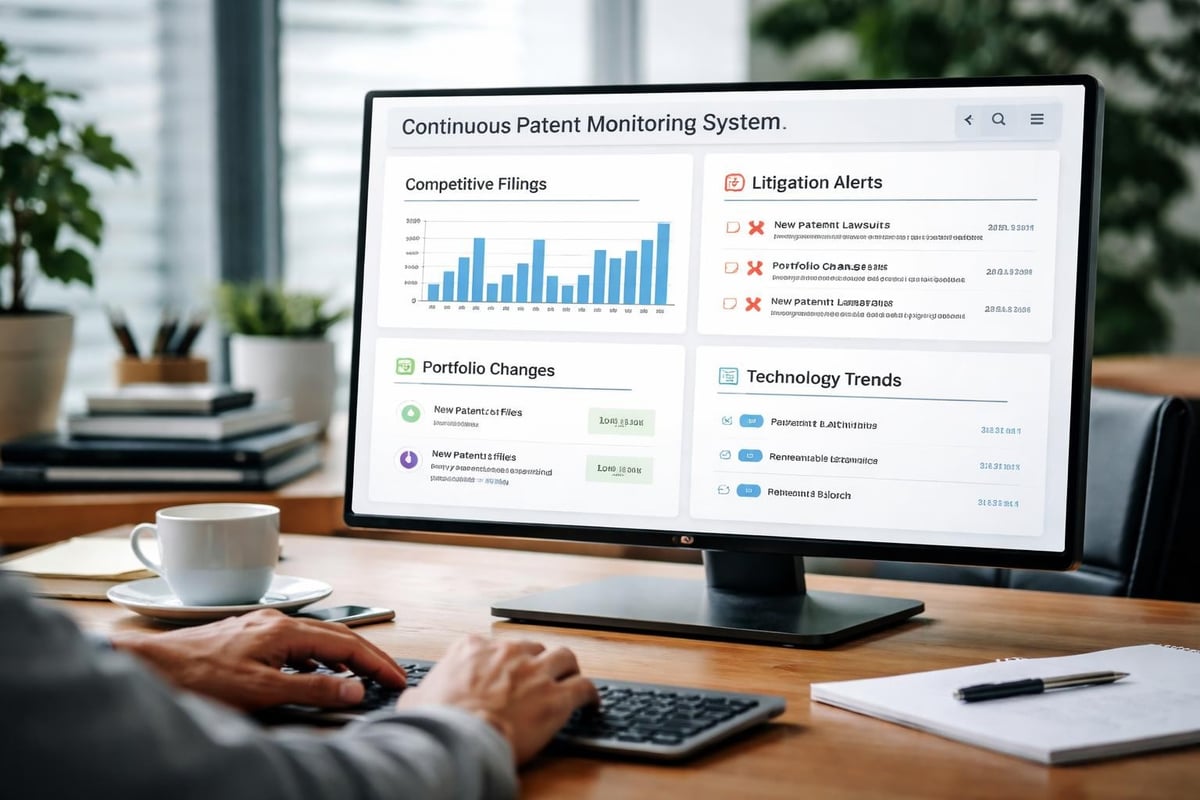
Effective monitoring systems, such as Moatwatch, alert deal teams to emerging threats and opportunities including:
- Competitor patent filings in core technology areas
- Litigation settlements or judgments affecting industry participants
- Patent expirations that erode competitive barriers
- Technology trends signaling market shifts
- Potential acquisition targets with complementary IP
This intelligence enables proactive management rather than reactive crisis response, a distinction that separates top-quartile performers from the broader market.
Sector-Specific IP Considerations
Different industries present unique patent intelligence challenges that require specialized analytical approaches within the pe business framework. Understanding these nuances prevents costly mistakes and identifies asymmetric opportunities.
Technology and Software
Software patents face heightened scrutiny following recent Supreme Court decisions and Patent Office examination guidelines. Due diligence in this sector must assess subject matter eligibility under evolving legal standards while evaluating defensive strength against non-practicing entities.
Manufacturing and Industrial
Physical product companies face freedom to operate challenges that software firms often avoid. Patent landscapes in manufacturing sectors include thousands of unexpired rights covering production methods, materials, and designs.
| Risk Category | Assessment Method | Mitigation Strategy |
|---|---|---|
| Component Infringement | Supplier IP warranties and indemnities | Alternative sourcing, design-around |
| Process Patents | Manufacturing facility audits | Licensing negotiations, process changes |
| Design Rights | Product tear-downs and claim mapping | Design modifications, clearance opinions |
These technical analyses require engineering expertise combined with patent law knowledge.
Building Internal IP Capabilities
Leading private equity firms develop systematic approaches to patent intelligence rather than treating each deal as a one-off exercise. This institutionalization creates competitive advantages through faster diligence, better risk assessment, and superior value creation.
Knowledge Management Systems
Firms completing multiple transactions annually accumulate substantial IP intelligence across portfolio companies and potential investments. Capturing and organizing this knowledge enables pattern recognition and comparative analysis that improves decision quality.
Effective systems include:
- Searchable databases of past diligence findings and issues
- Industry-specific patent landscape maps and competitive analyses
- Expert networks of technical advisors by technology domain
- Standardized diligence protocols and question libraries
These resources reduce duplication of effort while improving consistency across deal teams and fund vintages.
Strategic Partnerships
Rather than building full-time IP capabilities in-house, many pe business participants establish relationships with specialized patent intelligence providers. This approach provides access to deep expertise without fixed overhead costs, particularly valuable for mid-market firms completing fewer transactions annually.

Partnership models vary based on firm size, deal volume, and sector focus. Some investors prefer project-based engagements for individual transactions while others establish retainer relationships providing ongoing portfolio monitoring and strategic advisory services.
Exit Planning and IP Enhancement
The final phase of the private equity investment lifecycle presents critical opportunities to maximize IP-driven value. Evolving private equity strategies increasingly emphasize strategic positioning for exit from the initial investment decision.
Pre-Exit IP Strengthening
Strategic acquirers and public market investors scrutinize patent portfolios during buy-side diligence, making IP quality a key value driver. Portfolio companies benefit from systematic enhancement programs initiated 12-18 months before anticipated exit events:
- Continuation practice optimization to broaden claim coverage
- Foreign filing strategies that match international expansion plans
- Patent prosecution acceleration to secure granted rights before sale
- Prior art studies that validate key patent enforceability
- Licensing precedent establishment that demonstrates monetization potential
These initiatives require coordination between portfolio company management, outside patent counsel, and pe business deal teams to align IP strategy with exit objectives.
Acquirer Perspective Integration
Understanding how strategic and financial buyers evaluate IP assets enables sellers to position portfolios for maximum value recognition. Technology companies acquired by large corporations often justify premium multiples through defensive patent portfolios that protect broader product lines.
Financial buyers applying private equity investment frameworks focus on cash flow sustainability and competitive moat durability. Patent analytics demonstrating barriers to competitive entry directly address these concerns.
Competitive Intelligence and Market Positioning
Patent analysis extends beyond individual portfolio companies to inform broader sector strategies and competitive positioning. Sophisticated investors leverage IP intelligence for:
- Add-on acquisition identification through technology gap analysis
- Competitive benchmarking that informs operational improvement programs
- Market trend forecasting based on patent filing patterns
- White space identification revealing underserved market opportunities
This strategic application of patent intelligence transforms IP from a legal compliance function into core investment strategy, a shift that defines leading pe business practitioners.
Technology Trend Analysis
Patent filing patterns provide early signals of technological shifts and competitive movements before they appear in financial statements or market data. Analyzing application volumes, claim scope, and inventor networks reveals:
- Emerging technology domains attracting R&D investment
- Competitive repositioning by major industry participants
- University and research institution innovations seeking commercialization
- Geographic shifts in innovation centers and manufacturing capabilities
These insights inform investment thesis development and sector allocation decisions at the fund level, expanding IP intelligence value beyond individual transactions.
Building Sustainable Competitive Advantages
The integration of patent intelligence into pe business operations represents more than risk management or value enhancement. It creates sustainable competitive advantages in deal sourcing, execution, and value realization that compound across investment cycles.
Firms that develop systematic IP capabilities benefit from:
- Faster diligence cycles reducing time-to-close and competitive exposure
- Better risk pricing through accurate assessment of IP-related contingencies
- Enhanced value creation via proactive portfolio management
- Superior exit multiples reflecting strengthened competitive positions
These advantages matter most in competitive auction processes where speed, certainty, and price optimize seller selection criteria. Portfolio companies with demonstrable IP strength also attract higher quality management talent and strategic partners during the holding period.
For additional insights on implementing these strategies, explore resources at the Patent Intelligence Group blog covering current trends in IP due diligence and portfolio management.
Measuring IP Impact on Returns
Quantifying the contribution of patent intelligence to fund performance remains challenging given the multifaceted nature of value creation. However, leading firms establish metrics that track IP-related outcomes:
| Metric Category | Example Measures | Performance Indicator |
|---|---|---|
| Risk Avoidance | Post-close litigation incidents, IP-related write-downs | Lower frequency vs. industry baseline |
| Revenue Enhancement | Licensing income growth, royalty margin expansion | Percentage of portfolio EBITDA |
| Multiple Expansion | Exit valuation premium attributed to IP strength | Basis points vs. comparable transactions |
| Operational Efficiency | Diligence cost per transaction, time-to-close reduction | Year-over-year improvement trends |
These measurements enable investment committees to evaluate IP program effectiveness and allocate resources toward highest-impact activities across the deal lifecycle.
Patent intelligence has evolved from a specialized compliance function into a core competency for successful pe business operations across technology-intensive sectors. Firms that systematically integrate IP analysis into investment processes achieve superior risk-adjusted returns through better deal selection, pricing, and value creation during the holding period. Patent Intelligence Group provides private equity investors with independent patent intelligence services including comprehensive IP due diligence, portfolio assessment, and ongoing competitive monitoring through the MoatWatch™ framework, enabling informed investment decisions and sustainable competitive advantages.