
Investment Cases: Building Compelling IP-Driven Arguments
Investment cases serve as the foundation for critical financial decisions in private equity, litigation finance, and venture capital environments. These comprehensive documents synthesize market analysis, competitive positioning, financial projections, and risk assessments to justify capital allocation. For firms focused on intellectual property-driven opportunities, patent intelligence has become an indispensable component of building robust investment cases that withstand scrutiny from partners, limited partners, and investment committees.
Understanding the Strategic Role of Investment Cases
Investment cases function as both decision-making tools and accountability mechanisms. They force investors to articulate their assumptions, quantify expected returns, and identify potential obstacles before committing capital. Understanding investment thesis development provides the conceptual framework that supports the broader case for investment.
The core components of effective investment cases include:
- Executive summary highlighting the opportunity and expected returns
- Market analysis demonstrating addressable opportunity and growth trends
- Competitive landscape assessment identifying sustainable advantages
- Financial modeling with multiple scenarios and sensitivity analysis
- Risk evaluation including technical, market, regulatory, and execution risks
- Exit strategy outlining realistic paths to liquidity and return realization
Patent Intelligence as a Differentiator
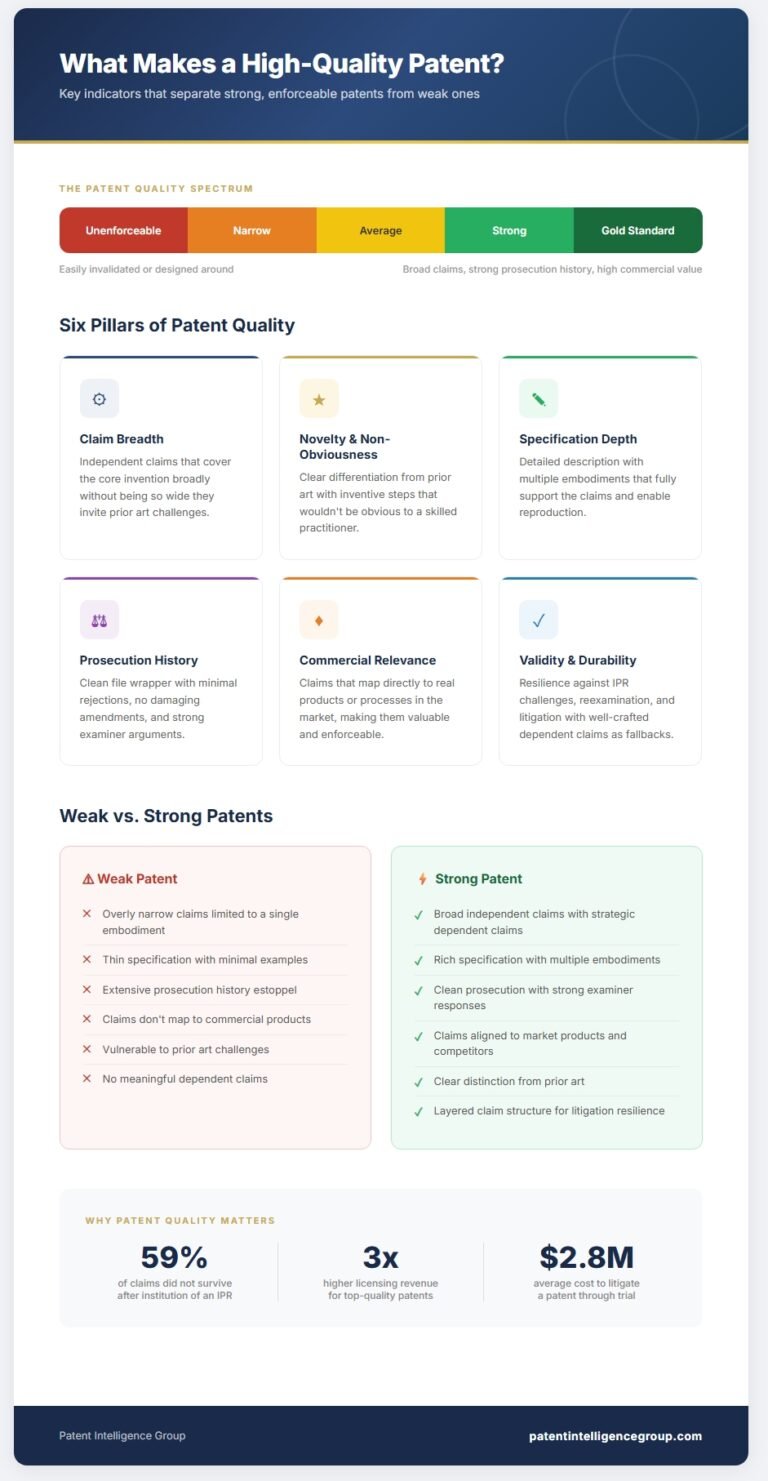
In technology-driven sectors, intellectual property often represents the most significant value driver and risk factor simultaneously. Patent portfolios can create formidable competitive moats, generate licensing revenue streams, or expose companies to costly litigation. Consequently, sophisticated investors now treat patent analysis as a non-negotiable element of their investment cases rather than an afterthought.
The integration of patent intelligence transforms investment cases from purely financial exercises into strategic assessments. By analyzing patent quality, freedom to operate, competitive positioning, and monetization potential, investors gain insights that traditional financial due diligence cannot provide.

Building Investment Cases for Private Equity Transactions
Private equity firms constructing investment cases face unique challenges related to control positions, operational improvements, and defined exit timelines. Patent intelligence contributes to each phase of the investment case development process.
Initial Screening and Opportunity Assessment
During preliminary evaluation, patent data helps investors quickly assess whether a target company possesses genuine technological differentiation or merely claims to be innovative. Analyzing patent filing patterns, citation networks, and competitive comparisons reveals whether the company's IP portfolio supports its market positioning claims.
| Assessment Dimension | Patent Intelligence Contribution | Impact on Investment Case |
|---|---|---|
| Market Position | Patent share analysis vs. competitors | Validates competitive moat claims |
| Innovation Velocity | Filing trends and R&D productivity | Projects future product pipeline |
| Technical Quality | Citation analysis and patent strength scoring | Assesses defensibility and value |
| Freedom to Operate | Third-party patent landscape mapping | Quantifies potential blocking risks |
This early-stage analysis determines whether to advance opportunities into full due diligence. Investment cases built on flawed assumptions about IP strength often lead to value destruction post-acquisition.
Deep Due Diligence and Value Creation Planning
Once a target passes initial screening, comprehensive patent due diligence informs the detailed investment case. This analysis examines patent ownership clarity, prosecution history, maintenance status, and potential infringement issues. The findings directly impact valuation assumptions, deal structure, and post-acquisition value creation strategies.
Developing thorough business cases requires meticulous documentation of assumptions and supporting evidence. For IP-intensive investments, this means quantifying how patent assets contribute to revenue protection, margin expansion, or strategic optionality.
Patent intelligence informs specific value creation initiatives:
- Licensing program development with quantified revenue potential
- Patent prosecution strategies to strengthen core assets
- Defensive portfolio building to reduce litigation exposure
- Strategic patent acquisitions to fill portfolio gaps
- Patent monetization through assertion or sale of non-core assets
Investment Cases in Litigation Finance
Litigation finance presents distinct requirements for investment cases compared to operating company investments. These cases must evaluate the probability of favorable outcomes, potential damage awards, litigation timelines, and defendant financial capacity.
Patent Litigation Case Assessment
Patent litigation investment cases combine legal analysis with technical evaluation and financial modeling. The patent intelligence component assesses claim validity, infringement evidence strength, and prior art that could invalidate asserted patents.
Experienced litigation funders structure their investment cases around specific questions that determine expected value. Is the asserted patent truly novel and non-obvious? Do the defendant's products practice the claimed invention? What damages theories apply, and what range of awards appears realistic?
The answers require deep patent analysis that goes beyond surface-level review. Claim construction analysis, file wrapper review, and technical expert evaluation all feed into the probability-weighted return calculations that justify funding decisions.
Portfolio Approach to Litigation Investment
Sophisticated litigation finance firms build investment cases that aggregate multiple matters into portfolios with diversified risk profiles. Patent intelligence enables this strategy by identifying cases with uncorrelated outcomes, varying timelines, and complementary risk characteristics.
| Portfolio Strategy Element | Patent Intelligence Application | Risk Management Benefit |
|---|---|---|
| Technology Diversification | Cross-sector patent analysis | Reduces industry-specific risk |
| Defendant Diversification | Multi-defendant case identification | Minimizes single-party dependency |
| Legal Theory Variation | Different infringement and validity theories | Balances legal precedent risk |
| Timeline Staggering | Cases at different litigation stages | Smooths cash flow requirements |

Quantifying Patent Value in Financial Models
Investment cases ultimately succeed or fail based on their financial projections and return calculations. Incorporating patent value requires translating qualitative IP strengths into quantitative financial impacts.
Revenue Protection and Pricing Power
Patents that protect core products or services enable premium pricing and sustained market share. Investment cases should model scenarios where patent expiration, invalidation, or design-around solutions erode these advantages. The delta between protected and unprotected scenarios quantifies the patent portfolio's contribution to enterprise value.
For example, a pharmaceutical investment case might model revenue cliffs when key patents expire, while a software company case might project gradual margin compression as competitors develop non-infringing alternatives. These scenarios help investors understand downside risks and evaluate whether the investment price adequately compensates for IP-related vulnerabilities.
Licensing Revenue Opportunities
Patent portfolios with broad industry applicability create licensing revenue streams that diversify business models and improve capital efficiency. Creating compelling investment memos requires realistic projections of licensing potential based on industry precedents, comparable licenses, and technical coverage analysis.
Realistic licensing projections consider:
- Total addressable licensee population based on patent coverage
- Historical industry licensing rates and deal structures
- Patent strength relative to existing licensing programs
- Management capability and willingness to pursue licensing
- Litigation risk and enforcement costs
Defensive Value and Risk Mitigation
Some patent portfolios create value primarily through risk reduction rather than revenue generation. Investment cases should quantify the expected cost of patent litigation, licensing demands from competitors, or product delays due to freedom-to-operate concerns. Strong defensive portfolios reduce these probabilities and associated costs.
Sector-Specific Considerations in Investment Cases
Different industries require tailored approaches to incorporating patent intelligence into investment cases. The relevance, value drivers, and risk factors vary substantially across sectors.
Technology and Software Investments
Software and technology investments face unique patent challenges including patent eligibility issues post-Alice, rapid technological change, and aggressive patent assertion entities. Investment cases must address how patent portfolios protect against both competitor patents and non-practicing entities.
The rise of standard-essential patents in telecommunications, networking, and emerging technologies like 5G creates both opportunities and risks. Crafting equipment investment business cases shares principles that apply to technology investments, where clarity about value drivers and risks proves essential.
Life Sciences and Biotechnology
Life sciences investment cases depend heavily on patent strength given the sector's reliance on regulatory exclusivity and IP protection. Patent term, pediatric exclusivity, data exclusivity, and patent linkage strategies all factor into financial projections.
Generic entry timing represents the most critical patent-related assumption in pharmaceutical investment cases. Even small shifts in loss of exclusivity dates can swing valuations by hundreds of millions of dollars, making thorough patent analysis indispensable.

Industrial and Manufacturing
Industrial companies often possess large patent portfolios covering manufacturing processes, materials, and product designs. Investment cases should assess whether these portfolios create genuine barriers to entry or represent routine innovations that competitors can easily design around.
Process patents can be particularly valuable but difficult to enforce since infringement occurs behind factory walls. Investment cases need realistic assumptions about enforceability and the practical competitive advantages these patents provide.
Presenting Investment Cases to Decision Makers
Even thoroughly researched investment cases fail if they cannot persuade decision makers. Effective presentation requires translating complex patent analysis into accessible insights that connect to financial outcomes.
Executive Summary Best Practices
The executive summary must distill patent intelligence findings into clear investment implications. Rather than describing patent counts or technical details, focus on what the IP position means for competitive advantage, revenue sustainability, or risk exposure.
Decision makers need to understand how patent factors affect the investment thesis. Does the patent portfolio support the claimed technological leadership? Do freedom-to-operate risks threaten the base case projections? Can licensing opportunities provide downside protection?
Visual Communication of IP Insights
Tables, charts, and graphics make patent intelligence accessible to non-technical audiences. Patent landscape maps showing competitive positioning, timeline charts illustrating protection duration, and scenario analyses demonstrating IP-related sensitivities all enhance investment case persuasiveness.
| Visualization Type | Purpose | Key Insights Communicated |
|---|---|---|
| Patent landscape maps | Competitive positioning | Relative IP strength vs. competitors |
| Citation network diagrams | Technology influence | Foundational vs. derivative innovations |
| Timeline charts | Protection duration | Revenue at risk from patent expiration |
| Scenario waterfall charts | Sensitivity analysis | Value impact of IP outcomes |
Addressing Investment Committee Questions
Anticipating and preparing for investment committee questions about patent-related assumptions strengthens investment cases. Common questions include: How did you validate patent strength? What happens if key patents are invalidated? How realistic are the licensing revenue projections?
Examining business case examples across industries reveals that successful cases address objections proactively and provide supporting evidence for key assumptions. Patent intelligence should be documented thoroughly so that specific claims can be verified and defended.
Ongoing Monitoring and Investment Case Updates
Investment cases are living documents that require updates as new information emerges. Patent landscapes evolve through new filings, litigation outcomes, licensing transactions, and regulatory changes. Sophisticated investors incorporate ongoing patent monitoring into their portfolio management processes.
Post-investment monitoring serves multiple purposes. It validates original investment case assumptions, identifies emerging risks requiring mitigation, and uncovers new value creation opportunities. When patent positions strengthen through successful prosecution or favorable litigation outcomes, investors can increase position sizes or adjust exit timing.
Conversely, negative developments like patent invalidations, adverse litigation outcomes, or competitor patent grants may require revised valuations, accelerated exits, or operational interventions. The MoatWatch™ framework exemplifies systematic approaches to ongoing patent intelligence that keep investment cases current and actionable.
Common Pitfalls in IP-Related Investment Cases
Understanding frequent mistakes helps investors build more robust investment cases. Patent-related errors often stem from over-reliance on patent counts, insufficient technical analysis, or failure to consider competitive responses.
Typical pitfalls include:
- Confusing patent quantity with quality or strategic value
- Ignoring prior art that could invalidate key patents
- Overestimating enforcement practicality for certain patent types
- Underestimating competitor design-around capabilities
- Failing to verify patent ownership and chain of title
- Neglecting international patent coverage in global markets
Building comprehensive business cases requires attention to detail and rigorous validation of assumptions. For patent-intensive investments, this means engaging technical experts, conducting thorough prior art searches, and stress-testing IP assumptions against competitive realities.
Another common mistake involves static analysis that fails to consider how patent positions change over time. Patent portfolios require ongoing investment in prosecution, maintenance, and enforcement. Investment cases should model these costs and assess whether portfolio companies have the resources and commitment to maintain IP advantages.
Integrating Patent Intelligence Throughout the Investment Lifecycle
The most sophisticated investors treat patent intelligence as a continuous thread running throughout the investment lifecycle rather than a discrete due diligence task. This integration begins during opportunity sourcing, intensifies during due diligence, informs post-acquisition value creation, and continues through exit preparation.
During hold periods, regular patent monitoring identifies competitive threats, validates operational strategies, and surfaces new monetization opportunities. Creating investment theses that guide decision-making establishes frameworks for evaluating how patent developments affect investment cases over time.
Exit preparation benefits from updated patent analysis that positions portfolio companies attractively for strategic acquirers or public market investors. Demonstrating patent strength, licensing potential, or freedom-to-operate clearance removes buyer concerns and supports premium valuations.
Investment cases that incorporate rigorous patent intelligence provide investors with competitive advantages in sourcing, executing, and exiting IP-intensive opportunities. By quantifying how patents create value, protect market positions, and introduce risks, investors make better-informed decisions that improve returns and reduce unexpected losses. Whether evaluating private equity acquisitions, venture investments, or litigation finance opportunities, patent analysis transforms investment cases from speculative projections into evidence-based strategic assessments. Patent Intelligence Group helps private equity firms, litigation finance funds, and investors build compelling investment cases through comprehensive IP due diligence, patent portfolio assessment, and ongoing MoatWatch™ monitoring that keeps your investment theses current and actionable.